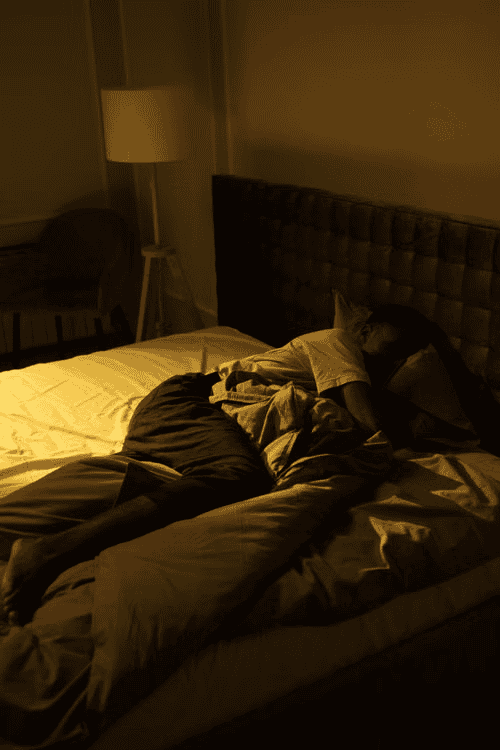
Most of us treat sleep as whatever’s left over after everything else. Work runs late, dinner runs late, there’s one more episode, and eventually the body gets whatever hours remain. Then we’re surprised when we feel like a phone at 4 percent.
The research on sleep is unusually consistent. Almost every system in the body seems to lean on it, and cutting it short causes trouble in ways that show up sooner than you’d think.
What’s going on while you’re out
Sleep isn’t one steady state. You move through stages in cycles of roughly 90 minutes. Light sleep leads into deep sleep, which is heavy on physical repair and dominates the first half of the night. REM sleep, when most vivid dreaming happens, gets longer as the night goes on. Brain activity in REM looks oddly similar to being awake, which is one reason researchers link it to memory and emotional processing.
This matters for a practical reason. If you consistently cut sleep from the end, say by setting an alarm two hours early, you lose a disproportionate share of REM. A six-hour night isn’t three-quarters of an eight-hour night. It’s a different mix.
There’s also the housekeeping angle. Animal studies suggest the brain clears out metabolic waste more actively during sleep, and human research is starting to point the same direction, though it’s early. I wouldn’t repeat the strongest versions of that claim at a dinner party. The broader point stands: sleep isn’t downtime, and the brain is busy.
How much you actually need
For adults, the major sleep organizations land on seven or more hours a night, and most people do best somewhere between seven and nine. Some people genuinely function well on less, but that group is much smaller than the number of people who claim to be in it. A useful test: if you need an alarm to wake up and feel foggy until your second coffee, you’re probably not one of the naturally short sleepers.
The catch is that sleep-deprived people are bad judges of their own impairment. In lab studies, people restricted to about six hours a night for two weeks performed as badly on attention tests as people kept awake for a full night or two, yet they rated themselves as only slightly sleepy. You adapt to feeling terrible, and you stop noticing.
What happens when you short-change it
The short-term effects are obvious to anyone who’s had a bad night: worse focus, slower reactions, shorter temper. Some studies of extended wakefulness found impairment comparable to being legally drunk after around 17 to 19 hours awake. Drowsy driving causes a real share of crashes, which is the sort of statistic worth remembering the next time you think you’re fine to drive after a bad night.
Over longer stretches, chronic short sleep is associated with higher risks of high blood pressure, heart disease, type 2 diabetes, weight gain, and depression. Association isn’t the same as proof of cause, and illness can also wreck sleep, so the arrows point both ways. But controlled experiments back up the direction. A few nights of restricted sleep in healthy volunteers measurably reduces insulin sensitivity and raises appetite hormones, and people tend to eat more, particularly of the salty, sugary stuff, when they’re tired.
The weekend catch-up plan only partly works. Sleeping in on Saturday feels wonderful, but the small experiments that have tested it found it doesn’t fully undo the metabolic damage from a short week, and it can push your body clock later, making Monday worse.
The things that actually help
Most good sleep advice is unglamorous, and most of it comes down to your body clock.
Keep a steady wake-up time. This matters more than bedtime. A consistent rise time anchors your circadian rhythm, and bedtime tends to sort itself out.
Get bright light early. Outdoor light in the morning tells your brain what time it is, even on a cloudy day, when it’s still far brighter than any indoor room. In the evening, do the reverse and dim things down.
Watch the caffeine clock. Caffeine has a half-life of around five to six hours, so that 4 p.m. coffee is still half there at 10. One well-known study found caffeine taken six hours before bed cut sleep by over an hour, even though people didn’t feel wired. If you’re sleeping badly, try a noon cutoff for a couple of weeks before blaming anything else.
Take alcohol seriously as a sleep disruptor. It helps you fall asleep and then fragments the second half of the night, suppressing REM early on. The nightcap is a bad deal.
Keep the room cool, dark, and quiet. Around 18°C (mid-60s Fahrenheit) suits most people. Your core temperature has to drop for sleep to start, and a stuffy room fights it.
Screens, melatonin, and other overrated fixes
The blue light story is real but overstated. Bright light in the evening does suppress melatonin, and phones are bright. But the stimulation from scrolling something upsetting, or from replying to email, probably matters at least as much as the wavelength. Put the phone down for that reason and don’t rely on the night-mode filter to rescue you.
Melatonin gets grabbed off pharmacy shelves like a sleeping pill, and it isn’t one. Meta-analyses find it shortens the time to fall asleep by a matter of minutes for most people. It’s more useful for jet lag and for people whose body clocks run late than for ordinary insomnia. Lower doses often work as well as the big ones, and product quality varies, so it’s worth checking with a pharmacist.
When it’s more than a rough patch
If you struggle to sleep at least three nights a week for three months, that’s clinical insomnia, and the first-line treatment isn’t a pill. It’s cognitive behavioral therapy for insomnia, usually called CBT-I. It works through things like limiting time in bed, getting up if you’ve been lying awake for around twenty minutes, and unlearning the anxiety that has attached itself to your mattress. Its results hold up better over time than sleep medication, and guidelines from bodies like the American College of Physicians recommend it first.
Loud snoring, gasping, or waking unrefreshed despite a full night can point to sleep apnea, which is common, underdiagnosed, and treatable. Ask a doctor about it rather than buying another pillow.
The short version
Sleep is the closest thing to a free performance enhancer that exists, and the people who sell expensive gadgets for it are competing with a dark room and a fixed alarm. Aim for seven-plus hours, get up at the same time, get some daylight, and cut the late caffeine and the nightcap. If that doesn’t work, see someone who treats sleep for a living.